Can AI Speaking Tutors Improve English Fluency? What the Research Actually Shows

The practice gap
Ask EFL teachers in Seoul, Taipei, Ho Chi Minh City or Osaka what limits their students' speaking development, and the answers converge. Classes are large. Timetables privilege reading, grammar and examination preparation. In a fifty-minute lesson with forty students, even a well-designed communicative task leaves each learner a few minutes of actual speaking at most. Outside the classroom, opportunities to speak English with anyone are often scarce, and for many learners the prospect of speaking in front of peers is a source of considerable anxiety.
AI conversational tutors appear to address each of these constraints at once. A learner can speak to a chatbot or voice assistant at any hour, for as long as they wish, without an audience. Large language models now sustain open-ended spoken conversation with a fluency and topical range that rule-based chatbots of a decade ago could not approach, and many applications add automatic speech recognition (ASR), pronunciation scoring and corrective feedback.
The question this review addresses is narrower than whether these tools are impressive. It is whether they improve learners' spoken English — and, in particular, oral fluency — in ways that research has actually measured. The distinction matters. More practice does not automatically produce more fluent speech, and positive learner attitudes do not automatically translate into measurable development. A tool's technological capability is a claim about what it can do. Educational effectiveness is a claim about what learners can do afterwards, and only the second is an empirical finding.
The answer that emerges from the current evidence is cautiously positive but considerably more qualified than either enthusiasts or sceptics tend to suggest. Meta-analyses consistently report moderate positive effects of conversational AI on speaking-related outcomes. Yet those syntheses aggregate heterogeneous outcome measures, the underlying studies are mostly short and small, and the construct of fluency — as second language acquisition (SLA) research defines it — has been measured far less often, and less rigorously, than headline claims imply.

What exactly are we asking AI to improve?
Much confusion in this literature stems from treating "speaking skills" as a single outcome. SLA research hThe answer that emerges from the current evidence is cautiously positive but considerably more qualified than either enthusiasts or sceptics tend to suggest. Meta-analyses consistently report moderate positive effects of conversational AI on speaking-related outcomes. Yet those syntheses aggregate heterogeneous outcome measures, the underlying studies are mostly short and small, and the construct of fluency — as second language acquisition (SLA) research defines it — has been measured far less often, and less rigorously, than headline claims imply.as long distinguished several dimensions of oral performance, and an intervention may affect one without affecting the others.
Fluency refers to the temporal and processing characteristics of speech: how fast a speaker produces language, how often and where they pause, and how much they hesitate, repeat or self-correct. Segalowitz (2010) distinguishes cognitive fluency (the efficiency of underlying processing), utterance fluency (measurable features of speech) and perceived fluency (listeners' judgements). Utterance fluency is commonly analysed along three dimensions: speed (for example, articulation rate or speech rate), breakdown (frequency, duration and location of pauses) and repair (repetitions, reformulations and false starts) (Tavakoli & Skehan, 2005). A meta-analysis of correlational studies by Suzuki, Kormos and Uchihara (2021) found that speed and pause-frequency measures are among the strongest predictors of listeners' fluency judgements — which is one reason to prefer objective temporal measures over global ratings when fluency is the outcome of interest.
Accuracy concerns the extent to which speech conforms to target-language norms of grammar and vocabulary. Complexity concerns the range and sophistication of the language used. Together with fluency, these form the complexity–accuracy–fluency (CAF) framework widely used in task-based research (Housen & Kuiken, 2009), and a recurrent finding of that research is that the three dimensions can trade off against each other.
Pronunciation is itself multidimensional. Applied linguists distinguish accentedness (how different speech sounds from a reference variety) from comprehensibility (how easy it is to understand) and intelligibility (whether it is actually understood). Many teachers now treat comprehensibility, rather than native-like accent, as the realistic goal.
Interactional competence — managing turns, repairing breakdowns, responding contingently to an interlocutor — and broader communicative competence are different again. A learner can become faster and less hesitant in monologue without becoming any better at co-constructing a conversation with another person.
Finally, affective variables — foreign language speaking anxiety and willingness to communicate (WTC) — are not language outcomes at all, though they plausibly influence whether learners speak enough to develop.
When a study reports that an AI tutor "improved speaking", the first critical question is therefore: improved what, measured how? A holistic rubric score from a single teacher-rater, a self-report questionnaire and a speech-rate measure from recorded monologues are not interchangeable kinds of evidence.
Why AI conversation might help: the theoretical case
The rationale for AI speaking tutors draws on several established strands of SLA theory, and it is worth stating them precisely, because each predicts benefits under specific conditions rather than in general.
The interaction hypothesis (Long, 1996) holds that conversational interaction promotes acquisition when interlocutors negotiate meaning: when communication breaks down and is repaired through clarification requests, confirmation checks and reformulations, learners receive modified input and feedback at precisely the point where their interlanguage is inadequate. A conversational agent can, in principle, provide such moves. Whether it does depends on design. Systems that ignore or silently accommodate errors offer interaction without negotiation.
The output hypothesis (Swain, 1985) argues that producing language — not only comprehending it — pushes learners to notice gaps in their knowledge, test hypotheses and move from semantic to syntactic processing. AI tutors clearly increase the quantity of output available to learners in low-exposure contexts. The open question is whether that output is pushed: whether tasks require learners to stretch their resources or merely allow them to repeat what they can already say.
Skill-acquisition perspectives offer the most direct link to fluency. On this view, fluency develops through the proceduralisation and automatisation of knowledge, which require extensive, repeated, meaningful practice under some time pressure. Classroom techniques such as task repetition work partly on this principle. AI tutors can supply practice volume — but volume alone is not sufficient; practice must be repeated, communicatively purposeful and sustained over time to yield automatisation, and automatisation is precisely what short interventions are least likely to capture.
Finally, the affective case rests on research into foreign language anxiety (Horwitz, Horwitz & Cope, 1986) and willingness to communicate (MacIntyre, Clément, Dörnyei & Noels, 1998). Learners who are anxious about speaking in front of peers or teachers may speak less, and speaking less reduces opportunities to develop. A non-judgemental machine interlocutor could lower that barrier. But the theoretical model also implies a limit: WTC is situated and interlocutor-specific, so reduced anxiety with a machine does not necessarily transfer to human interaction, which is where communicative competence is ultimately tested.
What the evidence shows
The meta-analytic picture
The evidence base has grown rapidly, and several meta-analyses now synthesise it. Their headline findings are broadly consistent: moderate positive effects of chatbot or dialogue-based practice compared with control conditions.
Bibauw, Van den Noortgate, François and Desmet (2022), synthesising 17 studies of dialogue-based CALL with 100 effect sizes, reported a medium overall effect on L2 proficiency development (d = 0.58). Importantly for this review, they described effects as established for vocabulary, morphosyntax, holistic proficiency and accuracy, and for lower-proficiency learners. Fluency was not among the outcomes for which they reported an established effect. They also found that form-focused and goal-oriented systems, system-guided interactions and corrective feedback were associated with stronger effects.
Zhang, Shan, Lee, Che and Kim (2023), analysing 61 samples from 18 studies, reported a moderate average effect (g = 0.527). Wang, Cheung, Neitzel and Chai (2024), in the Review of Educational Research, meta-analysed 70 effect sizes from 28 studies using robust variance estimation and found a positive overall effect on language learning performance (g = 0.484), with educational level, language level, interface design and interaction capability affecting effectiveness. Lyu and colleagues (2024), in the International Journal of Applied Linguistics, synthesised 31 studies with 41 effect sizes and reported a medium effect (g = 0.608), moderated by accessibility, modality, involvement of generative AI and the nature of comparison groups.
The most directly relevant synthesis is Hou and Min (2025) in ReCALL, which focused specifically on L2 speaking development. Across 16 studies and 89 effect sizes, it reported a moderate overall effect (g = .61), with significant moderation by type of system, the degree of meaning constraint the system imposed, and modality. Notably, it found no significant moderating effect of proficiency level, corrective feedback, intervention length, type of interaction or type of measure. The authors also note that the systems in their study pool were mostly rule-based rather than powered by generative AI.
Two cautions apply to all of these figures. First, they are averages across heterogeneous outcomes, instruments, learners and systems; high heterogeneity is reported in several of the syntheses, and a single pooled effect conceals wide variation. Second, "speaking" in these syntheses usually means whatever the primary studies measured — most often holistic speaking scores or rubric ratings — rather than fluency in the SLA sense. A moderate effect on speaking scores is real evidence, but it is not evidence specifically about fluency.
Pronunciation and ASR feedback
The evidence on pronunciation is somewhat clearer because the intervention is more constrained. Ngo, Chen and Lai (2024), meta-analysing 15 studies with 38 effect sizes from 2008 to 2021, found a medium overall effect of ASR-based training on ESL/EFL pronunciation (g = 0.69), with explicit corrective feedback associated with stronger effects. Individual studies also show why pronunciation outcomes must be disaggregated: in work cited in that review, ASR practice improved comprehensibility and spontaneous speech without significantly reducing accentedness. For teachers, this pattern is encouraging — comprehensibility is usually the more useful goal — but it also cautions against equating a pronunciation "score" from an app with communicative intelligibility.
Anxiety and willingness to communicate
Affective outcomes are where the Asian EFL evidence is most developed. Tai and Chen (2023) studied 112 eighth-grade learners in Taiwan using Google Assistant for two weeks and reported significantly increased WTC, greater communicative confidence and reduced speaking anxiety, supported by interview data suggesting a less threatening practice environment. Fathi, Rahimi and Derakhshan (2024), with 65 Iranian EFL learners, compared AI-mediated chatbot speaking activities with conventional peer interaction and reported advantages for the AI group on speaking (rated across fluency and coherence, lexical resource, grammatical range and accuracy, and pronunciation) and on WTC.
These are consistent with the theoretical case. They are also typical of the evidence in their limitations: short or modest interventions, single-site samples, self-report measures for affective outcomes, and immediate rather than delayed post-tests.
Novelty and sustained engagement
One of the most important findings is a caution. Fryer, Ainley, Thompson, Gibson and Sherlock (2017), in a 12-week counterbalanced experiment with 122 university students in Japan, found that task interest declined significantly over time with a chatbot partner but not with a human partner, and that only interest in tasks with human partners predicted later course interest. Huang, Hew and Fryer (2022), reviewing 25 empirical studies, identified the novelty effect — alongside technological limitations and cognitive load — as a central challenge. Short studies of new technology are especially vulnerable to measuring enthusiasm rather than learning.
The generative AI era
Large language model voice tutors are qualitatively different from the rule-based and scripted systems that dominate the meta-analyses above. They sustain longer, less constrained conversations, adapt to topic and level, and can be prompted to provide feedback or to play specific interlocutor roles. A growing number of primary studies since 2023 report positive results for such tools on speaking scores and affective outcomes. At the time of writing, however, much of this work consists of small quasi-experiments, frequently without random assignment, with short durations and with outcome measures of uneven rigour; studies that report objective temporal fluency measures (speech rate, pause frequency, mean length of run) with delayed post-tests remain uncommon. Evidence on the newest systems is therefore promising but provisional, and the meta-analytic averages above should not be assumed to transfer to them — in either direction.
How much weight can the evidence bear?
A moderate pooled effect size is a meaningful finding. It is also only as strong as the studies that produce it, and the primary literature on AI speaking practice shares several recurring weaknesses.
Outcome measurement. The single most important limitation for this review's question is that fluency is rarely measured as fluency. Many studies report holistic speaking scores, often from a single rater who knows which group each learner belongs to, or band-descriptor ratings in which fluency is combined with coherence. Studies reporting objective temporal measures — speech rate, mean length of run, pause frequency and location — are a minority. Without those measures, a claim that AI practice improves "fluency" usually means that it improves something raters judged favourably.
Comparison conditions. Effect sizes depend heavily on what the AI group is compared with. Comparing AI practice with no additional practice measures, in large part, the effect of extra speaking time. Comparing it with an equivalent amount of peer or teacher-led practice is a much stricter test, and fewer studies attempt it. Lyu and colleagues (2024) found the nature of comparison groups to be a significant moderator, which is exactly what this concern would predict.
Duration and retention. Interventions are commonly a few weeks long, with immediate post-tests. Fluency, if it develops through automatisation, is expected to change slowly and to require evidence of retention. Delayed post-tests are uncommon.
Sample and design. Many studies use intact classes, modest samples and quasi-experimental designs without random assignment. Researchers frequently teach the groups they study. Learner enthusiasm for a new tool can inflate both engagement and self-reported outcomes, as the novelty findings above suggest.
Transfer. Most studies assess speaking in tests or monologues, not in interaction with human interlocutors. Gains in a learner's comfort or performance with a machine cannot be assumed to transfer to classroom discussion, oral examinations or workplace conversation.
Publication bias and rapid change. Positive results are more likely to be published, and some meta-analyses report evidence of asymmetry. Meanwhile, the technology changes faster than studies can be designed, conducted and published, so the systems in the evidence base are often a generation behind the systems teachers are actually considering.
None of these limitations is unique to AI research; most apply to CALL research generally. Together, though, they mean that the strongest defensible claim is modest: conversational AI practice tends to improve speaking performance as typically measured in short-term studies, with the clearest evidence for pronunciation (especially with explicit ASR feedback), for some aspects of accuracy and vocabulary, and for affective variables. Evidence specifically for gains in temporal fluency is thinner and less rigorous.
The Asian EFL context: affordances and constraints
Asia is not a single educational context, and generalisations across Japan, Korea, China, Taiwan, Vietnam, Thailand, Indonesia and other systems should be made cautiously. Nonetheless, several features common to many Asian EFL settings bear directly on how AI speaking tutors are likely to perform.
The first is the exposure gap. Where English is rarely used outside school, opportunities for spoken practice are limited, and AI tools can supply quantity that classrooms cannot. This is the context in which the theoretical case for extra practice is strongest — and it is notable that much of the existing evidence base comes from East Asian research groups and learners.
The second is the examination environment. In systems where high-stakes examinations emphasise reading, grammar and vocabulary, or where speaking assessment is limited, learners and parents may judge any speaking practice by whether it raises test scores. AI tools that produce pronunciation or speaking scores can easily become another form of test preparation, emphasising score optimisation rather than communicative development.
The third concerns affect and face. Speaking anxiety and concern about making mistakes in front of peers are frequently discussed in research on Asian EFL classrooms, and studies such as Tai and Chen (2023) suggest that machine interlocutors can lower that barrier. The risk is that a comfortable private channel becomes a substitute for, rather than a bridge to, speaking with people.
The fourth concerns accent norms and ASR. Speech recognition and pronunciation scoring systems are trained on particular varieties of English and may evaluate learners against a narrow reference accent. Learners whose speech is perfectly comprehensible to other speakers of English as a lingua franca can receive low automated scores or frequent misrecognitions. For a region where most English use is between non-native speakers, an implicit native-speaker benchmark is pedagogically questionable.
The fifth is equity and infrastructure. Access to devices, reliable connectivity, quiet spaces for speaking practice and paid subscriptions varies widely within and between countries. Tools that work well for well-resourced urban students may widen gaps rather than close them.
The sixth is data and governance. Voice recordings of minors are sensitive personal data, and institutions must consider where recordings are processed and stored and what consent and data protection rules apply in their jurisdiction.
From evidence to practice: an integration framework
The evidence does not support treating AI tutors as replacements for teachers or classroom interaction. It does support using them as structured supplements, provided their use is aligned with what the research suggests works. Four principles follow.
Design the task, not just the tool. Bibauw et al. (2022) and Hou and Min (2025) both found that system characteristics — goal orientation, guidance and meaning constraint — moderated effects. Open-ended chatting is not necessarily the most productive use. Tasks with a clear communicative outcome, defined roles and a reason to speak at length are more consistent with task-based language teaching principles.
Build in repetition for fluency. If fluency is the goal, the most relevant classroom evidence concerns repeated performance of the same or similar tasks under increasing time pressure. AI tutors make repetition easy: learners can retell the same story, answer the same interview questions or repeat a role-play with variations.
Close the loop with human interaction. Use AI practice as preparation for human conversation, not as its endpoint: rehearsing with a tutor before a pair task, a presentation or an oral assessment. This addresses the transfer problem and makes it more likely that reduced anxiety carries over to real interlocutors.
Measure what matters, simply. Teachers can monitor fluency development without research instruments by recording short monologues periodically and noting speech rate and the frequency of long pauses, alongside comprehensibility judgements. App-generated scores should be treated as one indicator among several, not as the outcome.
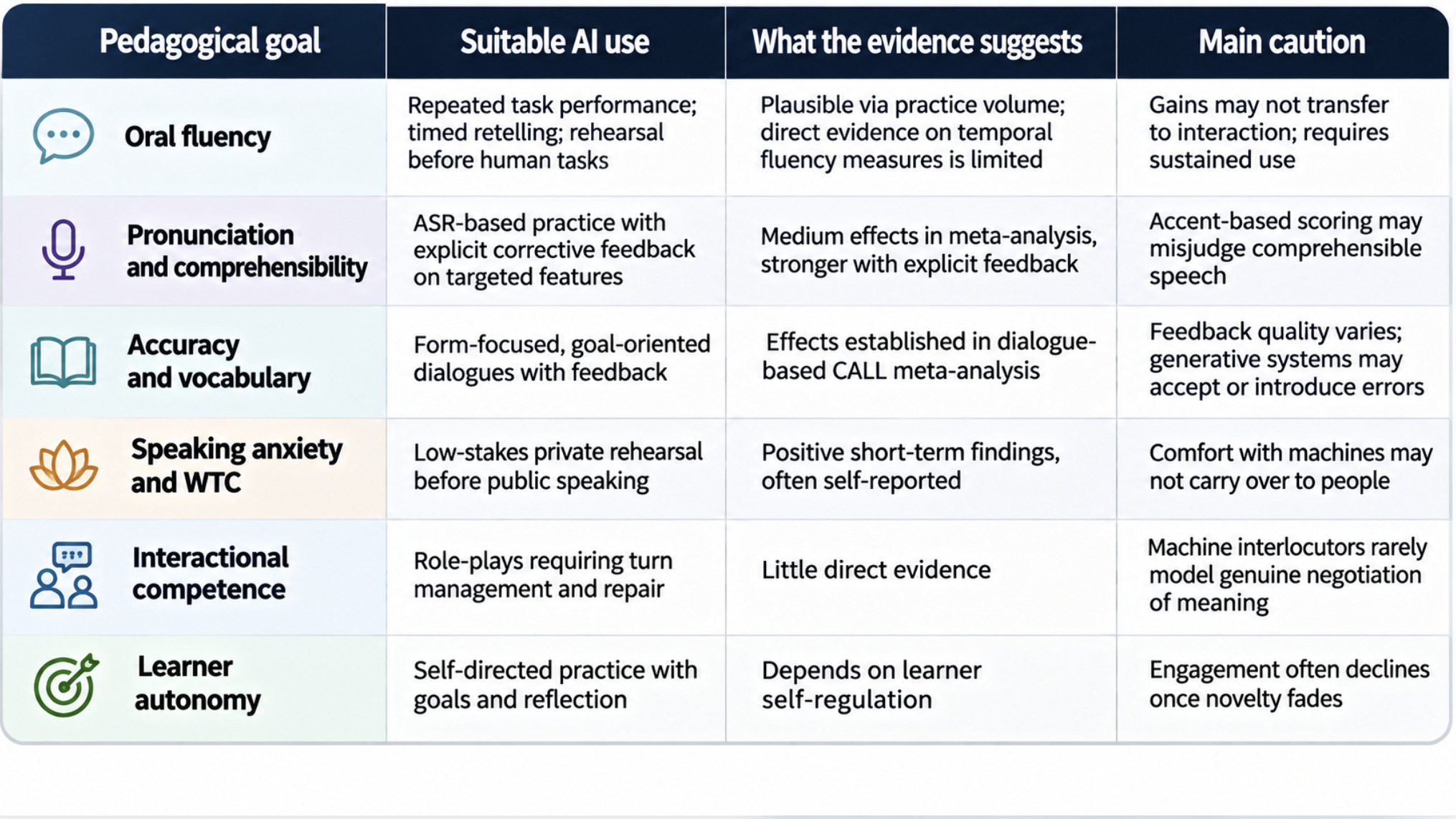
Teachers should also be explicit with learners about limitations: AI interlocutors can produce inaccurate corrections, may not notice errors, and may respond fluently to utterances that a human listener would struggle to understand. Teaching learners to treat AI feedback critically is part of responsible integration.
What the field still needs to know
The gaps identified above suggest a clear research agenda, and Asian EFL contexts — where both need and research capacity are high — are well placed to address it.
Studies of fluency should measure fluency directly, using established temporal measures of speed, breakdown and repair, ideally alongside listener-based perceived fluency, and report them separately from accuracy and complexity. They should compare AI practice with equivalent human-mediated practice, not only with no-treatment controls, so that the effect of the medium can be separated from the effect of additional speaking time. They should include delayed post-tests, and interventions should run long enough for automatisation to plausibly occur.
Research should also test transfer to interaction with human interlocutors, and examine interactional competence directly rather than inferring it from monologue performance. Studies of generative AI tutors should specify the system and its configuration — model, prompting, feedback settings, modality — since effects reported for one configuration may not hold for another. And research on ASR-based feedback should examine accent bias and its consequences for learners whose speech is comprehensible but non-standard.
Finally, there is a need for classroom-integrated designs: studies of how teachers actually use these tools over a semester or a year, what learners do when nobody is watching, and how engagement evolves after the novelty fades. Fryer and colleagues' findings on declining interest deserve systematic replication with contemporary systems.
Conclusion
Can AI speaking tutors improve English fluency? The honest answer is that they can plausibly contribute to it, that they demonstrably improve some aspects of speaking performance under some conditions, and that the specific evidence for gains in temporal fluency is thinner than the enthusiasm surrounding these tools implies.
The meta-analytic evidence is consistently positive and moderate in size. It is strongest for outcomes that are relatively easy to target and measure — pronunciation with explicit ASR feedback, accuracy, vocabulary and short-term affective change. It is weakest for the developmental, slow-moving construct that fluency represents in SLA research, and for interactional competence with human interlocutors. Studies are typically short, measure outcomes inconsistently and compare AI practice with weak alternatives. Systems based on large language models may offer more than the rule-based tools that dominate the existing evidence, but that remains to be demonstrated rather than assumed.
For teachers and programme designers in Asian EFL contexts, the practical implication is neither to adopt these tools uncritically nor to dismiss them. AI tutors can supply what many classrooms cannot: volume of low-stakes speaking practice. Whether that practice becomes fluency depends on task design, repetition, sustained use and deliberate connection to speaking with people. Technological capability is necessary for that outcome. It is not, on present evidence, sufficient.
References
Bibauw, S., Van den Noortgate, W., François, T., & Desmet, P. (2022). Dialogue systems for language learning: A meta-analysis. Language Learning & Technology, 26(1), 1–24.
Fathi, J., Rahimi, M., & Derakhshan, A. (2024). Improving EFL learners' speaking skills and willingness to communicate via artificial intelligence-mediated interactions. System, 121, 103254.
Fryer, L. K., Ainley, M., Thompson, A., Gibson, A., & Sherlock, Z. (2017). Stimulating and sustaining interest in a language course: An experimental comparison of Chatbot and Human task partners. Computers in Human Behavior, 75, 461–468.
Horwitz, E. K., Horwitz, M. B., & Cope, J. (1986). Foreign language classroom anxiety. The Modern Language Journal, 70(2), 125–132.
Hou, Z., & Min, S. (2025). Dialogue-based computer-assisted language learning systems for second language speaking development: A three-level meta-analysis. ReCALL. Advance online publication.
Housen, A., & Kuiken, F. (2009). Complexity, accuracy, and fluency in second language acquisition. Applied Linguistics, 30(4), 461–473.
Huang, W., Hew, K. F., & Fryer, L. K. (2022). Chatbots for language learning—Are they really useful? A systematic review of chatbot-supported language learning. Journal of Computer Assisted Learning, 38(1), 237–257.
Long, M. H. (1996). The role of the linguistic environment in second language acquisition. In W. C. Ritchie & T. K. Bhatia (Eds.), Handbook of second language acquisition (pp. 413–468). Academic Press.
Lyu, B., Lai, C., et al. (2024). Effectiveness of chatbots in improving language learning: A meta-analysis of comparative studies. International Journal of Applied Linguistics. Advance online publication.
MacIntyre, P. D., Clément, R., Dörnyei, Z., & Noels, K. A. (1998). Conceptualizing willingness to communicate in a L2: A situational model of L2 confidence and affiliation. The Modern Language Journal, 82(4), 545–562.
Ngo, T. T.-N., Chen, H. H.-J., & Lai, K. K.-W. (2024). The effectiveness of automatic speech recognition in ESL/EFL pronunciation: A meta-analysis. ReCALL, 36(1), 4–21.
Segalowitz, N. (2010). Cognitive bases of second language fluency. Routledge.
Suzuki, S., Kormos, J., & Uchihara, T. (2021). The relationship between utterance and perceived fluency: A meta-analysis of correlational studies. The Modern Language Journal, 105(2), 435–463.
Swain, M. (1985). Communicative competence: Some roles of comprehensible input and comprehensible output in its development. In S. M. Gass & C. G. Madden (Eds.), Input in second language acquisition (pp. 235–253). Newbury House.
Tai, T.-Y., & Chen, H. H.-J. (2023). The impact of Google Assistant on adolescent EFL learners' willingness to communicate. Interactive Learning Environments, 31(3), 1485–1502.
Tavakoli, P., & Skehan, P. (2005). Strategic planning, task structure, and performance testing. In R. Ellis (Ed.), Planning and task performance in a second language (pp. 239–273). John Benjamins.
Wang, F., Cheung, A. C. K., Neitzel, A. J., & Chai, C. S. (2024). Does chatting with chatbots improve language learning performance? A meta-analysis of chatbot-assisted language learning. Review of Educational Research. Advance online publication.
Zhang, S., Shan, C., Lee, J. S. Y., Che, S., & Kim, J. H. (2023). Effect of chatbot-assisted language learning: A meta-analysis. Education and Information Technologies, 28(11), 15223–15243.
How to cite this article
Imogen Thackray (2026) ‘Can AI Speaking Tutors Improve English Fluency? What the Research Actually Shows’, Asian EFL Journal, 6 November 2026. Available at: https://asian-efljournal.com/content/can-ai-speaking-tutors-improve-english-fluency-what-the-research-actually-shows/